a wee bit o’ baking

2015-01-18 bread--natural leaven
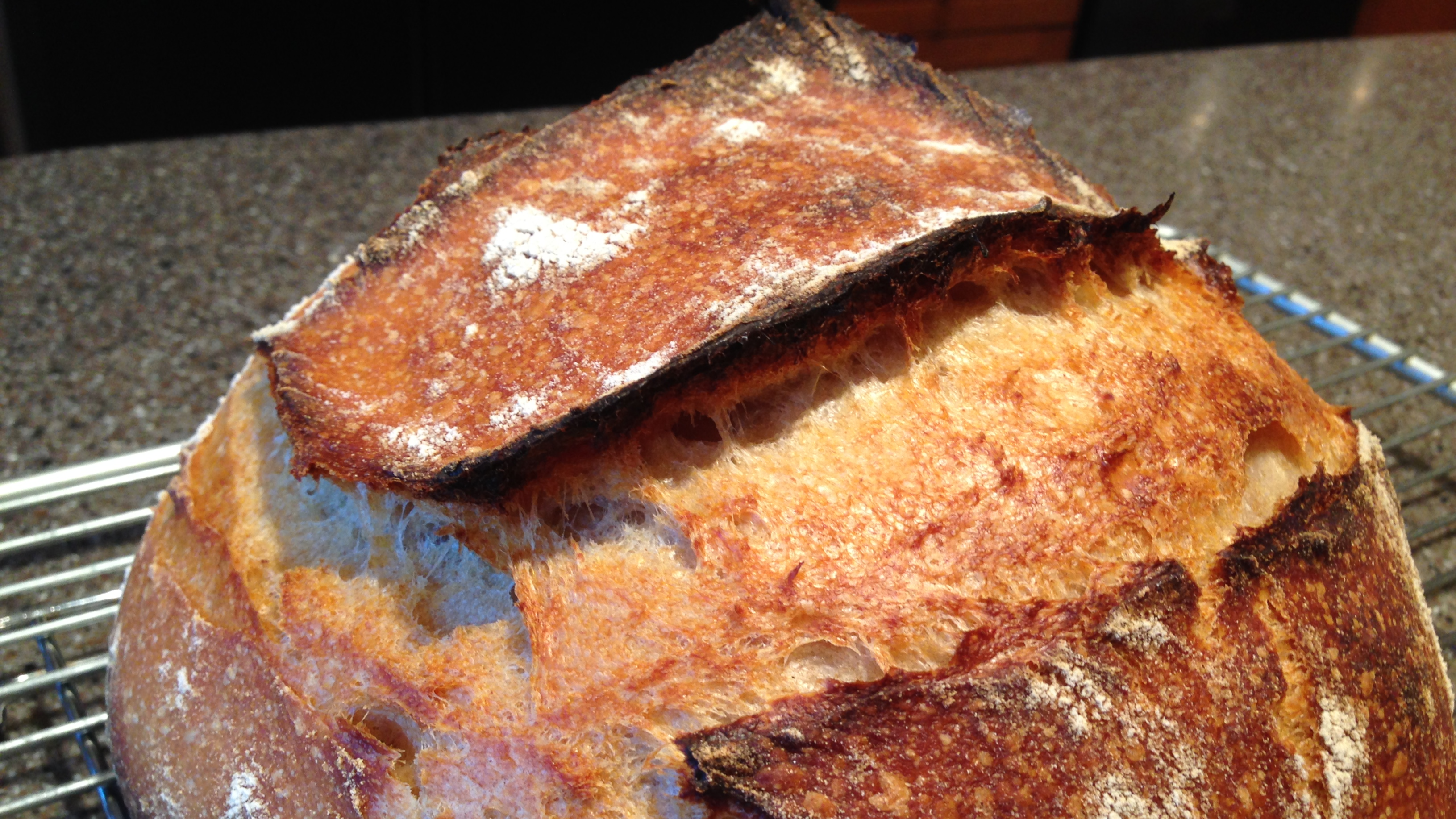
Tartine Country White

Well, it’s been over four years since I have added any new material to this space. What have I been doing? Most recently, I have been baking bread. Here is a photo of my latest loaf, soon to be joined by two more tomorrow morning. I am experimenting with timing. Today I mixed it up and did the bulk ferment, shaped the loaves, and put them in the refrigerator at 10pm.  I expect that the flavor will be more complex and acidic. Guess I will have to wait until morning to find out!

eleven days of fermentation

On January 31, I began my seed culture for my first loaf of sourdough bread. For days I have checked in with its babysitter, Bill. I’m still waiting to try the bread (supposed to wait 45 minutes before slicing).

Okay, as you can see, we have begun eating. I’m quite satisfied with the crumb for this first loaf.

lavash crackers

As bread recipes go, this was quite easy. First of all, it did not require a sponge or a soaker, so that meant that we could eat the crackers the same day I started making them. Of course, the crackers in the picture below look exactly perfect. Now that I’m a cracker veteran, I’m thinking that the cookbook photographer gave an extra spray of water–or shellac–to make them look so shiny.


the ideal basket of crackers [picture from the book]

The hardest part was rolling the dough out to approximately 12×15 inches so that it would fit in my sheet pan. I had to trim some of the dough off because it hung over the edges of the pan.


my 12 x 15 inches of dough–exactly!

One disappointing thing–other than the lack of shininess–was that the crackers didn’t brown evenly. The edges browned more quickly and in the center, the crackers were just not as crisp. Next time I will roll the dough out even thinner and then bake it in two shifts. That should make for crisp crackers!


fresh from the oven

Here’s the finished product. The topping is a combination of sesame and poppy seeds and kosher salt. Since I didn’t have a wire basket, I put them in my kauri wood bowl that I brought back from New Zealand.


bowl of crackers

panning for gold

Here’s what $1.76 will buy: a vast improvement on my previous sieve. This device makes it much easier to extract the wheat bran from the germ. Since wheat bran is a main ingredient in the current family favorite Multigrain Extraordinaire, it only made sense to shell out the dough (pun intended . . .)


my new sieve

french bread redux


the finished product

This is the first time that I have repeated a bread recipe. It is also the first time that I have made a mistake. Fortunately, with my vast baking experience, I was able to recover from the potentially catastrophic consequences by “mama macgyverin'” through the crisis. [see prior post on this subject] The stakes were high, as bread baking goes–after all, I had already invested a day in the pate fermentee and the bread was expected for a family dinner in Springfield that same evening.

My mistake? In an effort to follow the directions precisely, I had taken the temperature of the water I was to add to the dough; because it was a little cool, I added hot water, thinking to myself that I would get rid of the excess. The next time I thought about it, my dough was swimming in nearly twice as much water as the recipe required. It was one of those moments where time slows down–as does sound. Noooooooooooooo. Keeping in mind that ancient peoples did not have measuring equipment to make their daily bread, I added flour and what I thought to be a proportionate amount of yeast and salt until the dough was tacky but not sticky, as the directions indicated.

Now I had way too much dough for making baguettes, as planned (constrained by the size of my oven, only two racks, and the single sheet pan that I own). Plan B: make two boules and hope that they don’t merge into each other while rising.


parchment paper proofing

P.S. the bread was . . . excellent!

anadama bread

I’ve been a busy girl these past few days. I guess that I am combining two hobbies right now–baking and photography. This bread gets its warm color tones from the corn meal and molasses and sun.

In the book that was a Christmas gift from Pam and Hugh (The Breadbaker’s Apprentice), the author suggests that one use the lightest molasses that can be found–because the taste is so strong and objectionable to some people. Well, I had already bought my molasses and it was very dark. I did NOT care for the smell of molasses. In fact, when I encountered the odor, I decided to put five tablespoons instead of six in the bread dough. However, the bread was extremely tasty–although not up to the standard set by yesterday’s experiment–Multigrain Extraordinaire.

Usually when the afternoon sun streams through my kitchen windows, I close the blinds. But this time, the sunbeams fell on my golden bread and I thought . . . what a nice photo op.

Anadama bread fresh from my oven!

mama macgyver

Whenever there is need for creative thinking, I always remember Richard Dean Anderson’s character on the ’80s television show MacGyver. That guy could make a radio antenna out of gum wrappers. (His character was probably originally inspired by the Professor on Gilligan’s Island).

My recipe called for wheat bran, but I could not find it anywhere in the grocery store. When I returned home and consulted the cookbook again, Peter Reinhart (author) said in a sidebar comment that wheat bran could be extracted by running whole wheat flour through a very fine sieve. Daaang. I was fresh out of very fine sieves, and it was 11:30 p.m., so I had to improvise. In order for me to be able to make this multi-grain extraordinaire bread tomorrow, I had to soak the grains tonight!

Bill had already gone to bed, so I quietly rummaged through my dresser drawer in the dark, searching for my stash of knee-hi stockings. Now, my wardrobe hasn’t required knee-hi’s for quite some time, but I eventually extracted one and returned to the kitchen. First, I slipped it over a large serving spoon. It was miraculous! After a few minutes’ work, I had separated a small mound of bran. Underneath, in the spoon, was the rest of the wheat. However, at this rate, I would be harvesting grain all night long.

That is when I decided to build a tool with a larger surface area. The results can be seen below. It was a lot of work for two tablespoons of wheat bran, and wouldn’t you know it, the multi-grain extraordinaire bread went on to become the family’s favorite, so far. Daaaaaaang.


harvesting some wheat bran–eli whitney would be proud

tres baguettes

Today’s project is to fashion baguettes. Actually, this was a two-day affair because I first had to make the pate fermentee. This is a mixture of flour, salt, yeast, and water that gets a day’s headstart in order to imbue the bread with more flavor. Here is how it looks after a day of fermenting and just before it is incorporated into the main dough:


pate fermentee

My baguettes are quite pale in color. I believe that is because I used organic flour. The book says to add in some sort of barley additive if using organic flour to give it a darker color. Hrrrmph. Same ol’ story. I don’t happen to have barley whatchamacallit; fer cryin’ out loud, I thought I was pretty hot stuff for having organic flour!


as the well-known French pirate Pepe le-Pop-Eye might say, “moi baguettes”

tools of the trade

Confession: I occasionally exhibit obsessive/compulsive tendencies. (mmmmm . . . from whence do they come?) Case in point: in order for me to enjoy this little baking hobby that has ambushed me, I need to have everything organized. Flour is quite messy and difficult to control. Here is how I have decided to store my ingredients. I have baked several loaves of bread w/my new storage system in place and it seems to be working out . . . perfectly. Mom, Dad, and Grandma? This is where I spent some of the Christmas money. Thank you.


Merry Christmas from Mom and Dad and Grandma!